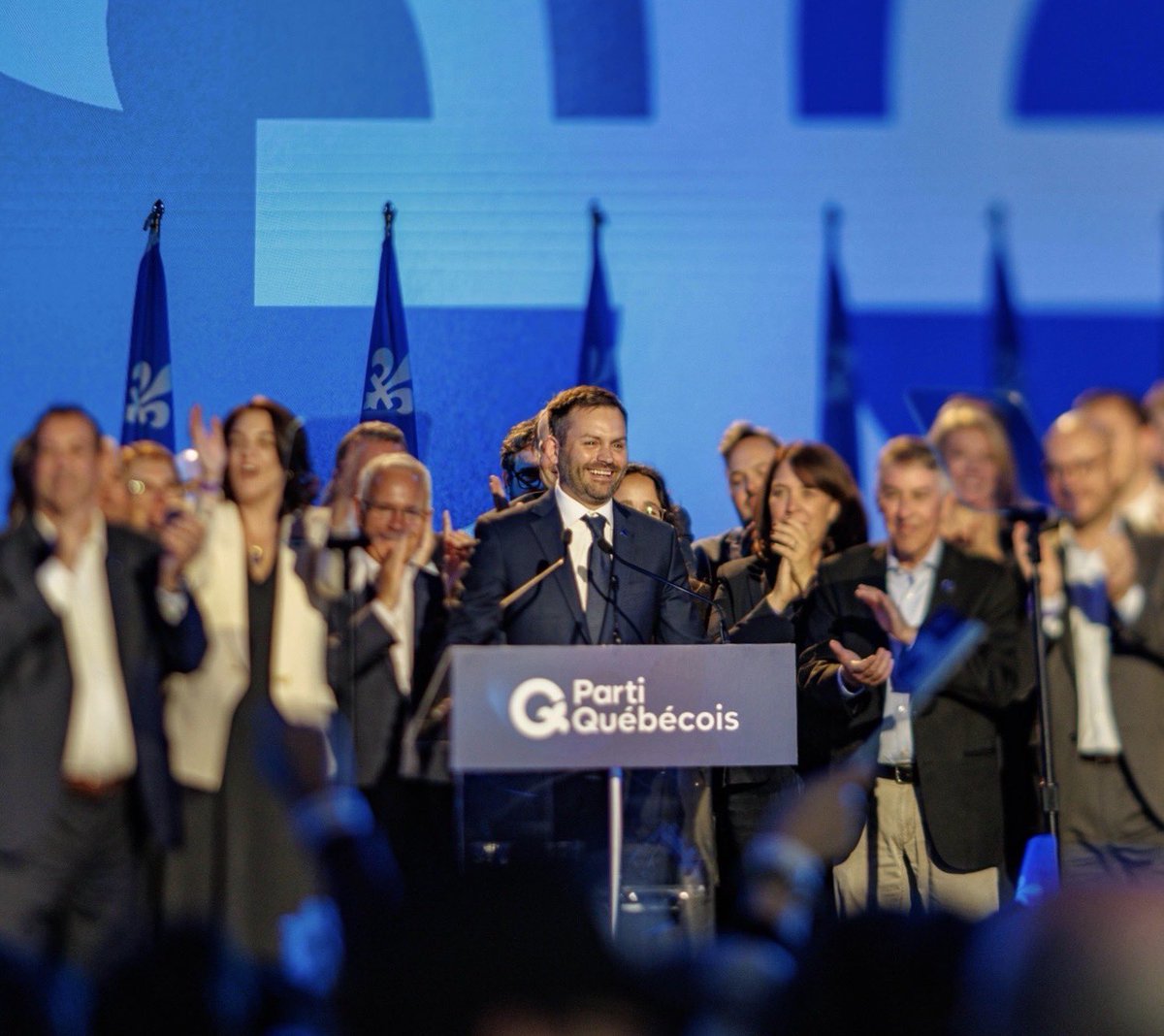
Headlines show a separatist/sovereignist government as the votes were counted in the 44th Quebec General Election. New Premier-designate Paul St-Pierre Plamondon and his caucus of 59 Members of the National Assembly will lead a minority government at a consequential time in our nation's history. And the implications of this go far beyond the borders of the province over which the Fleurdelisé flies. For the first of three major votes in Canada this fall, the story is one of desire for change, a seeming discontent with the state of the nation, but a tepid desire to tackle tough constitutional questions.
The facts as the numbers came in are that the once undefeatable CAQ went from a massive majority of more than 90 of the 127 seats in the National Assembly to being totally shut out, being projected to not win any. While the party did get more than 13% of the vote, the Premier in her concession speech took responsibility for the loss, but clearly former Premier François Legault’s legacy hung heavy over the vote. The state of Quebec, and the pocketbook issues facing the province clearly played an outsized role in the political result. The Parti Québécois and its leader, premier-designate St-Pierre Plamondon won with about 28% of the final tally, and by any objective measure do not have a strong mandate in a National Assembly that will be far from stable. He did, in his remarks, signal his willingness to be a premier for all, even speaking briefly in English, however, in his victory speech held firm to the “project of independence” and seemed committed to following through on his promise for a referendum.
The biggest winner and biggest loser are clear; however the full results present a far more complicated tapestry and is a far from simple narrative. First for Quebec, the issue of separation was seen to drag the popularity of the separatist Parti Québécois down. The Liberals made gains but failed to capitalize on the fears of Mr. Trump to the south and seems to show that the popularity of Liberal Prime Minister Mark Carney was not enough to lead to victory, however did nearly double their seat count. The Conservatives returning to the National Assembly for the first time in nearly a century, is seen as a victory and is one of two opposition parties that hold the balance of power in the minority, and a voice not seen in the National Assembly for a very long time. Éric Duhaime held true to his principles and made an appeal to English Quebec in English, not targeting any group other than those who feel held hostage by the Liberals and made it clear that he does not support a referendum. Likewise the Québec solidiaire claimed victory and made it clear that the progressive agenda will be their priority, despite losing seats from the previous election and ended up two down from their 2022 result.
Now the country grapples with the results… it is clear that there was an appetite for change… But the change in the case of the Quebec electorate was diverse. For Liberal Prime Minister Mark Carney, he now has a vocal opponent that pushes an agenda that will no doubt come into direct conflict with his agenda, and will face a new and persistent test that shows both him and his political allies that popularity does not mean long term political security. For Alberta the result is already being tossed around as a victory for breaking up the federation by separatists/sovereigntists… but the reality is much less than that. The referendum promise split the PQ’s base between loyalists who demanded it and voters who clearly did not. For Alberta federalists, the message obviously is that while separatism in Canada remains on the agenda, the popular support for it remains complicated and far from a plurality. What seems to unite frustrated Canadians, whether in Alberta, Quebec, or even possibly in B.C., is not a burning desire for tearing the federation apart but rather a remedy: a return to Section 92 where Ottawa is required to respect the diversity of provincial jurisdiction and the myriad of impacts that were framed into how the nation is supposed to work. For the Conservatives, there is a glimmer of hope that there is a breakthrough in a region that was previously seen to be untouchable, and that the message that Éric Duhaime, similar to federal Conservative leader Pierre Poilievre, resonated in a previously undiscovered voter base, but with the parallel that it led to an increase in support but not to victory.
Now with a referendum on Alberta’s pursuit of independence only weeks away, and B.C. facing what appears to be shifting political tides… Quebec’s result is less a bellwether on the person who takes the seat in the premier’s chair, but more the complications our nation faces that manifest themselves at the ballot box. October will prove to be a consequential moment that tests the strength of not only our political leaders, but also the constitutional framework that has made this diverse and vast nation weather storms like this before. The foundation of the nation is stronger than is given credit. Provincial autonomy is not a threat, but the very glue that can hold the nation together, unity despite our differences is possible. Our distinct regions and their defining characteristics are what hold us together from sea to sea.
Damien C. Kurek is the former Conservative Member of Parliament for Battle River—Crowfoot. He is currently a principal at Upstream Strategy Group and continues to farm in Alberta’s Special Areas.