BC's New Conservative Government - Upstream Analysis
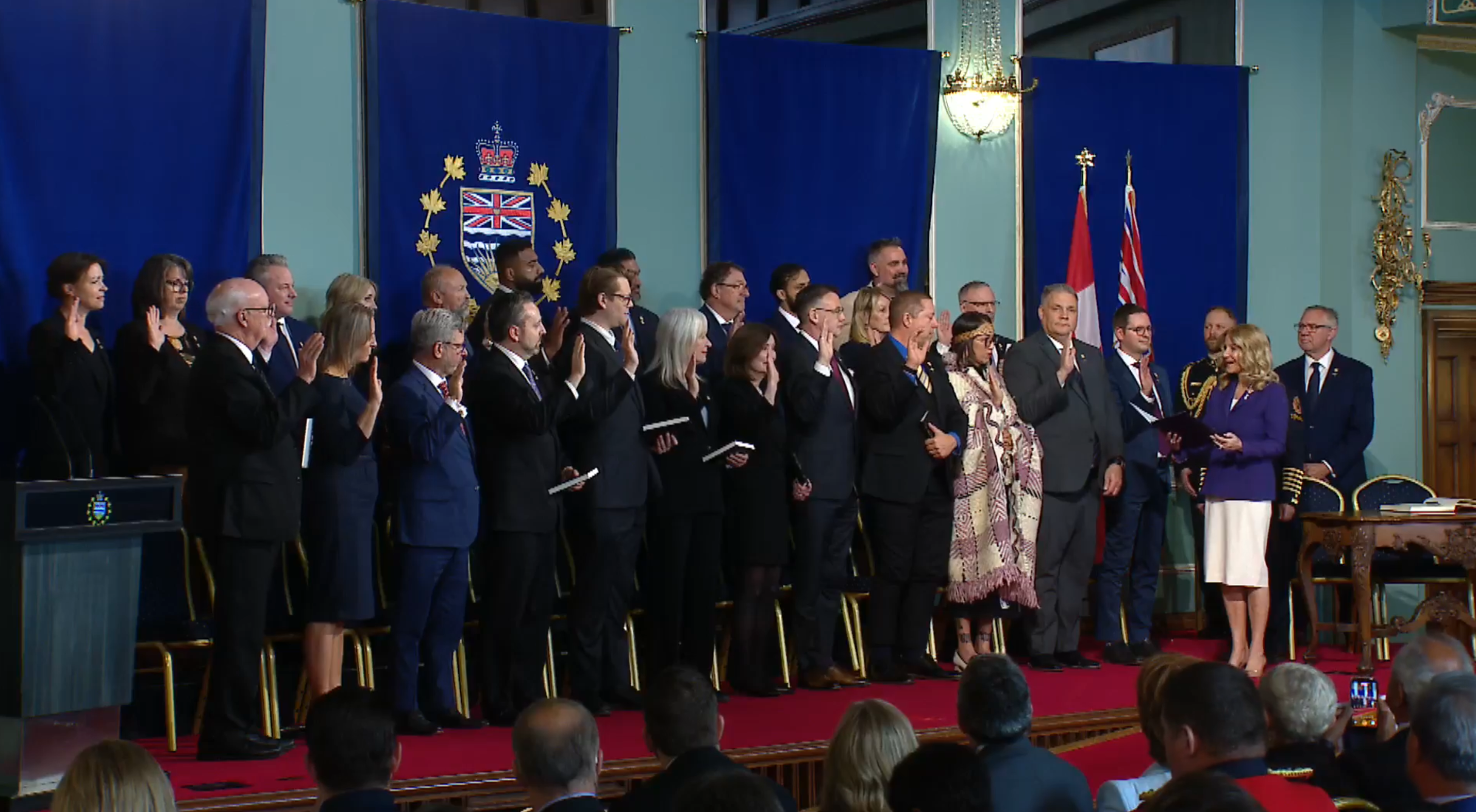
Premier Lorne Doerkson today swore in British Columbia's first Conservative cabinet in nearly a century, less than a month after the BC Conservatives won a commanding majority in the October 24 snap election. The new executive council has 18 portfolio ministers (plus the premier) and six ministers of state, supported by 12 parliamentary secretaries.
The cabinet is organized around five stated priorities: an Affordable BC, a Prosperous BC, a Healthy BC, a Safer BC, and a Strong and Proud BC. The lineup blends experienced former BC Liberal and BC United legislators with first-term MLAs elected in 2024 and 2026. It also brings back to the front bench several moderates who left the caucus this summer and returned under Doerkson. Below, we set out who holds each file and the background they bring to it.
Cabinet Ministers
Cabinet ministers lead a ministry. Each is responsible for that ministry's policy direction, legislation and operating budget, and is individually accountable under BC law for keeping the ministry within its budget. For stakeholders, these are the decision-makers who own a file end to end.
Premier – Hon. Lorne Doerkson (Cariboo-Chilcotin). Before politics, Doerkson was a newspaper publisher, financial planner, Rotary president and rodeo announcer. First elected as a BC Liberal in 2020, he joined the Conservatives in 2024 and was re-elected that year. With a leadership vacancy caused just days before the snap election was called, Conservative MLAs selected Doerkson to lead them, and quickly announced that he would remain as the permanent leader should the party form government. With the confidence of his team of MLAs, Doerkson united the party and was elected on a sensible and approachable conservative platform.
Minister of Social Development and Deputy Premier – Hon. Claire Rattée (Skeena). A former Kitimat city councillor (2014–2018) and longtime co-owner of a Kitimat small business, Rattée served as opposition critic for mental health, addictions and housing supports. She has spoken openly about her own path through addiction and recovery, which she says shapes her focus on treatment access—an important commitment made by the party during the recent election. She is also a fierce advocate for liquefied natural gas (LNG). LNG Canada's Kitimat facility sits in her riding, and she has championed the project since her time on Kitimat council. Rattée ran for the Conservative Party of Canada in an overlapping electoral district in the 2019 federal election.
Minister of Finance – Hon. Peter Milobar (Kamloops Centre). Kamloops' longest-serving mayor (2008–2017), Milobar has been an MLA since 2017 and served as opposition finance critic under both BC United and the Conservatives. He is the most experienced legislator at the cabinet table and inherits a projected $13.8-billion deficit for 2026/27. Milobar's central task will be turning the platform's tax commitments into a credible budget. The Conservatives pledged no new taxes or tax increases, a higher basic personal exemption (from about $13,000 to $32,000, worth roughly $1,000 for nearly every working British Columbian), and removing the PST from Canadian beer, wine and spirits, certain business machinery, equipment and software, and major projects until they begin operating.
Attorney General – Hon. Caroline Elliott (West Vancouver-Capilano). A first-time MLA, Elliott was a political commentator and former BC Liberal ministerial staffer who came within two points of winning the Conservative leadership in May. Elliott has a PhD in Political Science with a focus on Indigenous governance and is an outspoken advocate for property rights. Her appointment is a strong signal of the new government's commitment to repealing many of the previous government's measures, including DRIPA, which causes investment uncertainty by harming Crown Land use and resource projects.
Minister of Economic Development and Tourism – Hon. Gavin Dew (Kelowna-Mission). An Oxford MBA and former candidate for the BC Liberal leadership in 2022, he joined the BC Conservatives in 2024 and was elected in that autumn's election. Dew was the opposition critic for jobs, economic development, innovation and AI. His new ministry role adds tourism to his previous critic position. Dew owned several child care businesses prior to entering politics.
Minister of Energy, Mines and Petroleum Resources – Hon. Larry Neufeld (Peace River South). A professional engineer and business owner from Dawson Creek, he was first elected in 2024. In opposition, Neufeld served as critic for oil, gas and LNG. He has been a vocal supporter of new pipeline and energy infrastructure developed in partnership with Indigenous communities.
Minister of Forests – Hon. Kiel Giddens (Prince George-Mackenzie). A former Prince George Chamber of Commerce president, Giddens led public affairs for the Coastal GasLink pipeline and previously spent six years working in the BC Legislature. Following his 2024 election, he served as opposition labour critic.
Minister of Agriculture – Hon. Ian Paton (Delta South). A third-generation Delta farmer with more than 30 years running a dairy farm and farm auction business, Paton has represented Delta South since 2017. He served as agriculture critic under the BC Liberals, BC United and the Conservatives.
Minister of Water, Land and Natural Resource Operations – Hon. Donegal Wilson (Boundary-Similkameen). Raised on a cattle ranch near Tulameen, Wilson was executive director of the BC Snowmobile Federation from 2012 to 2024, working with government, industry and backcountry users. She was opposition critic for water, land, fisheries and wildlife management. She was elected in 2024 as a Conservative and was one of the MLAs to leave the caucus over dissatisfaction with the previous leadership, but returned when Doerkson took over the reins.
Minister of Environment – Hon. Áʼa:líya Warbus (Chilliwack-Cultus Lake). A member of the Skowkale First Nation and the first Stó:lō person elected to the Legislature, Warbus is the daughter of former Lieutenant Governor Steven Point. She previously served as Opposition House Leader from her election in 2024 until the 2026 election and worked as director of cultural communications for the Stó:lō Xwexwilmexw Government.
Minister of Indigenous Relations and Reconciliation – Hon. Scott McInnis (Columbia River-Revelstoke). A Kimberley-based educator, McInnis was elected in 2024 and served as opposition critic for Indigenous relations, as well as tourism, resort municipalities and the Columbia River Treaty.
Minister of Transportation and Infrastructure – Hon. Trevor Halford (Surrey-White Rock). First elected as a BC Liberal in 2020, Halford served as interim Conservative leader from December 2025 until May 2026 and Leader of the Official Opposition until June 2026, and was seen as a stabilizing force as the party went through a leadership process. He has previously served as critic for TransLink and ICBC.
Minister of Local Government, Housing, Sport and Culture – Hon. Cathie Ounsted (Saanich South). A first-time MLA, Ounsted is a former Central Saanich councillor and former chair of the Victoria Airport Authority who co-operates a local accounting firm with her husband. She flipped a seat the NDP had held since 2005.
Minister of Citizens' Services and Technology – Hon. Bruce Banman (Abbotsford South). A former chiropractor and small business owner, Banman was mayor of Abbotsford from 2011 to 2014 and has been an MLA since 2020. In 2023, he became the second sitting MLA to join the Conservatives.
Minister of Health – Hon. Ryan Peterson (Coquitlam-Burke Mountain). A first-time MLA, Peterson co-founded Port Coquitlam's Finger Food Studios in 2011 and grew it into a 200-person technology company, and served as the chair of the Business Council of British Columbia before stepping away to run. His appointment suggests this government may look to technology to play a key role in health care reform.
Minister of Public Safety and Solicitor General – Hon. Jessy Sahota (Surrey-Serpentine River). A decorated police officer, Sahota was named one of the top 40 police officers under 40 by the International Association of Chiefs of Police. He is also an international wrestling, jiu-jitsu and kabaddi athlete and longtime youth volunteer in Delta. He was also the Conservative Party of Canada candidate in 2025 in an overlapping federal electoral district.
Minister of Children and Family Development – Hon. Kristina Loewen (Kelowna Centre). A longtime Kelowna realtor and former doula, Loewen was first elected in 2024 and served as critic for social development and poverty reduction. Loewen faced two close elections, winning by just 40 votes in 2024 and 43 in 2026. The 2026 result is subject to a judicial recount next week.
Minister of Education and Child Care – Hon. Lynne Block (North Vancouver-Seymour). A career educator, former West Vancouver school trustee and recipient of the Prime Minister's Award for Teaching Excellence, Block served as opposition education critic. First elected in the neighbouring riding of West Vancouver-Capilano in 2024, she switched ridings in 2026, defeating NDP incumbent Susie Chant.
Minister of Post-Secondary Education and Labour – Hon. Korky Neufeld (Abbotsford West). Neufeld has more than 30 years' experience in the construction industry and previously served for 15 years as a trustee on the Abbotsford Board of Education, including as chair. He was opposition critic for post-secondary education and international credentials.
Ministers of State
Ministers of state are full members of cabinet, but they do not run a ministry or control its budget. Each is assigned a focused priority and works alongside the minister responsible for the broader file. Three of the six have an obvious lead ministry: Mining sits with Energy, Mines and Petroleum Resources, Housing with Local Government, Housing, Sport and Culture, and Labour with Post-Secondary Education and Labour.
BC also holds ministers of state to specific targets. Under the Balanced Budget and Ministerial Accountability Act, Treasury Board sets each minister of state's expected results by regulation, and 10 per cent of their salary is held back until those results are met. Once published, those expected results are one of the clearest public signals of what the government wants delivered on each priority.
Minister of State for Red Tape Reduction – Hon. Carson Binda (Vancouver-Quilchena). The former BC director of the Canadian Taxpayers Federation, Binda was elected for the first time in October. He has long advocated for lower taxes, regulatory reduction and spending restraint.
Minister of State for Rural Development – Hon. Anna Kindy (North Island). A Campbell River family physician and addiction specialist with roughly four decades in medicine, Kindy competed in moguls at the 1992 Winter Olympics. She served as the Official Opposition critic for health.
Minister of State for Mining – Hon. Pete Davis (Kootenay-Rockies). Raised in Cranbrook, Davis was a longtime federal Conservative riding association organizer before his election in 2024. He served as critic for mining, critical minerals and the Columbia River Treaty.
Minister of State for Housing – Hon. Zeeshan Wahla (Surrey City Centre). A professional engineer who runs an engineering consulting business, Wahla immigrated to Canada and settled in Surrey. First elected this fall, Wahla was a candidate in 2024, coming just 232 votes short. As an engineer, he brings a technical, development-side lens to the housing supply file.
Minister of State for Labour – Hon. Harman Bhangu (Langley-Abbotsford). A Surrey-born, first-generation Canadian who worked as an aggregate hauler in the trucking industry, Bhangu was a party vice-president before his election in 2024. He served as transportation critic and entered the race for party leadership in 2026, but withdrew before voting began and endorsed Caroline Elliott.
Minister of State for Emergency Management – Hon. Ward Stamer (Kamloops-North Thompson). Stamer spent his early career in the forest industry and served as mayor of Barriere from 2018 until his election in 2024. He brings direct local experience in a region repeatedly affected by wildfire, and served as opposition forests critic.
Parliamentary Secretaries
- Rosalyn Bird – Armed Forces and Veterans Affairs
- Margareta Dovgal – Children and Youth with Special Needs
- Steve Kooner – Insurance Corporation of British Columbia
- Misty Van Popta – Infrastructure
- Megan Knight – Metro Vancouver
- Tracy St. Claire – Rural Health
- Sharon Hartwell – Seniors
- Mandeep Dhaliwal – Sport and Culture
- Sacha Peter – Technology and Innovation
- Jody Toor – Tourism
- Harj Dhaliwal – TransLink
- Bryan Tepper – Urban Policing
What This Means
The cabinet is built for an economic and fiscal agenda first. Experienced hands hold the central levers: Milobar at Finance, Dew at Economic Development, and a resource bench of Neufeld, Davis, Giddens, Wilson and Paton. Dedicated ministers of state for red tape and mining signal that permitting timelines and regulatory reform will be early, visible priorities.
Doerkson has also chosen to unify rather than reward loyalty alone. Several politically moderate MLAs who left the caucus over the summer, including Milobar, Paton, Banman, Warbus and Wilson, now hold significant portfolios, as does former interim leader Trevor Halford. Leadership runner-up Caroline Elliott goes straight to Attorney General. The result is a cabinet that unites the party's former BC Liberal/United and grassroots Conservative wings.
At the same time, a large share of the social and service portfolios, including Health, Housing, Public Safety and Children and Family Development, go to first- or second-term MLAs. Many of these ministers will rely heavily on their deputy ministers and political staff early on. That makes the next several weeks of ministerial transition an important window for stakeholders to build relationships and frame their issues.
What Comes Next
In the coming weeks, expect mandate letters setting out each minister's priorities, the appointment of deputy ministers and additional political staff, and early decisions on the government's legislative agenda. The first Doerkson budget, expected in the new year, will be the clearest test of how the government balances its tax and affordability commitments against a projected $13.8-billion deficit. The judicial recount in Kelowna Centre is also worth watching.
New ministers are now receiving their transition briefings, and their offices will be setting stakeholder priorities quickly. Organizations with business before the provincial government should be reviewing their asks against the five stated priorities and preparing to engage. If you would like to discuss what the new cabinet means for your organization, please reach out to the Upstream team.