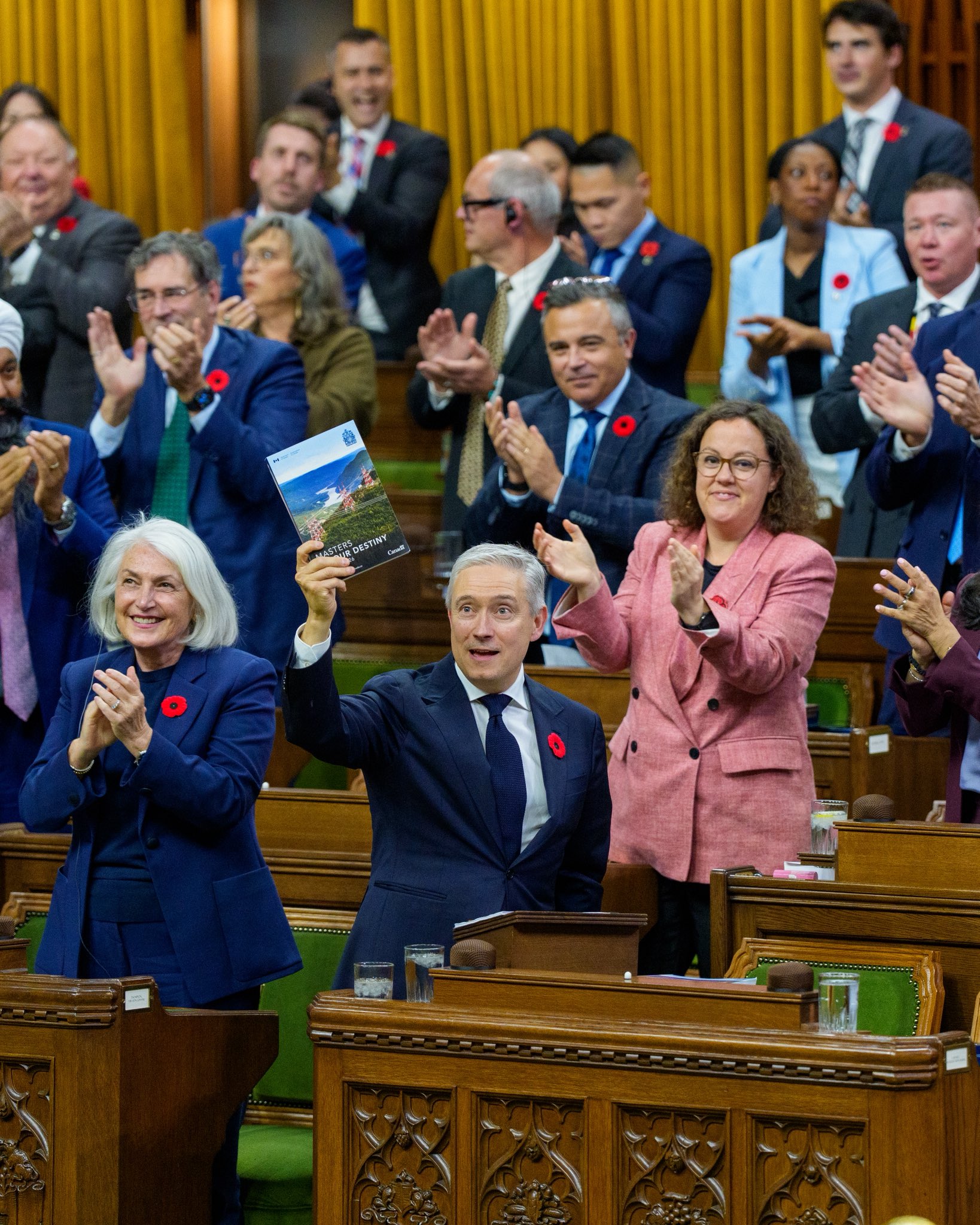
Finance Minister François-Philippe Champagne tabled Prime Minister Mark Carney’s second federal budget yesterday, titled Masters of Our Destiny. Framed against escalating geopolitical friction, ongoing trade instability with the United States, and volatile global energy markets, Budget 2026 charts an aggressive, capital-heavy course. The fiscal plan projects a deficit of $62.3 billion for the 2026–27 fiscal year on total federal expenditures of $602.9 billion and revenues of $540.3 billion. While the 2025–26 deficit was revised downward to $39.3 billion (bolstered by resource revenues and a $27.5-billion operational adjustment since the Spring Economic Update), structural deficits remain locked in above $50 billion annually through the end of the decade, finishing at $52.9 billion in 2030–31.
The government continues to lean heavily into its split accounting framework, segregating day-to-day operational spending from long-term capital investments. Under this ledger, the Carney Liberals claim they will achieve an "operational balance" by 2027–28—one year ahead of schedule—projecting an $11.2 billion operating surplus that widens to $25.2 billion by 2030–31. However, this accounting divide masks a massive, debt-financed capital buildout. The federal debt-to-GDP ratio hovers around 40% across the forecast horizon (peaking at 40.4% in 2028–29 before ticking down to 40.1% in 2030–31), while public debt servicing costs rise toward $60 billion annually.
Carney and Champagne have framed this budget around the historic rallying cry “maîtres chez nous”, pitching state-backed capital mobilization, domestic energy security, and trade diversification as the only shield against American protectionism. Mainstream media coverage has mirrored this tension: legacy outlets have characterized the budget as Carney’s defining technocratic gamble—a massive, $36-billion bet on supply-side corporate tax deductions and industrial strategy to ignite an "Investment Supercycle", set against relatively modest, short-term consumer relief that has left cost-of-living critics dissatisfied.
Key Budget Commitments
The Investment Supercycle & Tax Competitiveness
The centerplate of Budget 2026 is the Productivity Mega Deduction, a permanent expansion of immediate expensing that allows businesses of all sizes to write off 100% of the cost of eligible investments on day one.
- Expanding eligible asset coverage from 15% to over 65% (including software, data infrastructure, advanced machinery, pipelines, and rail track), the measure carries an estimated fiscal cost of $36.1 billion over five years.
- Finance calculates that this lowers Canada’s marginal effective tax rate (METR) on new business investment from 13.0% to 6.4%, making Canada the most tax-competitive jurisdiction in the G7 and cutting the effective tax burden to less than half that of the United States (16.9%).
- To foster scale and curb founder departures, the budget introduces the Canada Growth Incentive (CGI), granting builders a tax exemption on up to 15 million in capital gains from eligible investments, alongside an enhanced small business rollover to defer taxes when reinvesting into Canadian enterprises (715 million over four years).
- Innovation programs see significant structural rewiring: $930 million over five years to expand Scientific Research and Experimental Development (SR&ED) eligibility into commercialization and IP retention, $1 billion for the Strategic Response Fund, and $750 million deployed through the BDC for early- and growth-stage capital.
Energy Sovereignty & Major Projects
Budget 2026 doubles down on energy and project delivery through the Major Projects Office (MPO), backed by proposed legislative amendments under the Building Canada Strong Act to enforce a "one project, one decision, one year" regulatory standard.
- The government highlighted 28 nation-building initiatives referred to the MPO (representing $194 billion in capital expenditure and an estimated 200,000 jobs per year during construction), including Alberta's Pacific Link Pipeline and Pathways Plus, British Columbia's LNG Canada Phase 2 and North Coast Transmission Line, and Ontario’s Darlington New Nuclear Project.
- The National Electricity Strategy commits over $50 billion to double grid capacity by 2050. To back this, the Clean Technology and Clean Electricity Investment Tax Credits (ITCs) are extended to 2040, expanding eligibility to highest-voltage intra-provincial transmission lines.
- The Canada Strong Fund is formally unveiled as an arm's-length, $25-billion national sovereign wealth fund taking minority equity stakes in commercial projects alongside institutional partners. Retail access will be offered through principal-protected "Canada Strong Notes."
- Ottawa is moving to commercialize transportation hubs by introducing 40- to 50-year private operating concessions for Canada’s four largest airports, retaining land ownership while tapping private and pension capital for modernization.
Affordability & Housing Continuum
Recognizing acute consumer pressures, the budget delivers $22 billion in targeted affordability measures over five years, heavily front-loaded into temporary supports:
- A one-time 2027 Canada Groceries and Essentials Benefit Supplement will provide an additional $4.1 billion in early 2027, representing a 50% top-up for over 12 million low- and modest-income Canadians (up to $2,570 for a family of four).
- The temporary suspension of the federal fuel excise tax (saving up to 10¢/L on gas) is extended through January 31, 2027, phasing down to 50% relief until March 31, 2027, after which it expires.
- The National Heat Pump Rebate commits $2 billion to retrofit one million homes, projecting average household heating savings of $1,400 annually.
- Housing policy shifts toward direct state construction and social housing: nearly $45 billion on a cash basis across three pillars, headlined by $11.2 billion committed to a 10-year strategy to end homelessness. For the market sector, Ottawa raised the price ceiling for mortgage loan insurance from $1 million to $1.5 million and expanded 30-year amortizations for first-time buyers and new builds.
Defence Industrial Policy & Sovereignty
Responding to international security pressures and NATO commitments, Canada is sharply accelerating defence expenditures:
- Core defence and security outlays will reach 3.7% of GDP (75.1 billion core) in 2026–27, crossing 4.1% by2027–28 (89 billion) on a funded trajectory toward 5% by 2035.
- The $7.7-billion Defence Industrial Strategy mandates that 70% of defence acquisitions be awarded to domestic suppliers, targeting an industrial workforce expansion from 38,000 to 89,000. Priorities include up to 12 conventionally powered Arctic patrol submarines, six Canadian Coast Guard icebreakers built at Lévis, and the establishment of the Canadian-headquartered Defence, Security and Resilience Bank (DSRB).
- Domestic security measures include establishing a new Financial Crimes Agency by fall 2027, cracking down on crypto ATMs and money laundering via Bill S-8, and introducing digital safety regulations for AI and social media platforms through Bills C-34 and C-36.
National Unity, Culture, and Reconciliation
- Arts and culture receive $4 billion over five years, including the new Canada Creative Credit (providing up to $45,000 in tax relief on original artistic income), $300 million to stabilize CBC/Radio-Canada, and permanent free museum admission for youth under 25 via the Canada Strong Pass.
- Indigenous reconciliation measures feature $32 billion over 10 years for First Nations on-reserve housing and community infrastructure, alongside an expansion of the $10-billion Indigenous Loan Guarantee Program to back major resource acquisitions, such as the Tla’amin Nation Tree Farm in BC.
The Political Battle Lines
The Federal Conservatives: “Mastered by Debt”
Official Opposition Leader Pierre Poilievre immediately moved a non-confidence motion to reject the budget, framing it as a "costly credit card budget" that inflates the cost of living. The Conservative critique zeroes in on the government's dual-ledger framework, alleging that the separation of operational and capital budgets is an accounting trick designed to hide $476 billion in non-budgetary transactions and Crown debt.
Poilievre emphasized that the federal government is set to borrow a staggering 765 billion over the next five years (44,000 per Canadian household), driving public debt servicing costs above $60 billion annually—outstripping the Canada Health Transfer by $17 billion by 2030–31. The Conservatives also took aim at the upcoming spring expiration of fuel tax relief, the exclusion of core traditional sectors like agriculture, forestry, and mining from the Canada Growth Incentive’s capital gains breaks, and what Shadow Minister Michelle Rempel Garner termed "ghost numbers" in the revised immigration targets, arguing that backdoor administrative pathways push real permanent resident numbers closer to 580,000 against a 380,000 nominal cap. This in the shadow of alleged ethics violations, the Prime Minister will have fierce opposition from Conservatives as the Prime Minister may have his most challenging political battle ahead as he is still relatively new to an opposition.
The NDP: Corporate Giveaways vs. Cost of Living
From the left, NDP Leader Avi Lewis attacked the budget as "Christmas come early for CEOs, foreign investors, and arms dealers." The NDP’s core line of attack points to the massive disparity in spending priorities: the $36-billion Productivity Mega Deduction represents 50% more spending than all new affordability measures combined. Lewis slammed the government for letting military spending consume one out of every four federal dollars by 2030 while completely omitting Pharmacare from the 511-page document.
The friction spilled directly onto the national stage during a fiery, unscripted live television debate on the CBC budget special between Lewis and Finance Minister Champagne. Lewis confronted Champagne over the planned 40- to 50-year airport concessions, characterizing them as backdoor privatization that will enrich private pension barons and drive up travel fees for ordinary families, while demanding to know why corporations get permanent mega-deductions while working Canadians receive a one-time $20-per-month grocery benefit.
The Bloc Québécois: Co-opting Sovereignty and Undermining Provincial Autonomy
The Bloc Québécois delivered a scathing response, accusing the federal government of hijacking the historic language of Quebec's Quiet Revolution. Yves-François Blanchet and finance critic Jean-Denis Garon argued that repeating "maîtres chez nous" twenty times in the budget cannot mask Ottawa's centralization agenda. The Bloc noted that the unilateral implementation of the Mega Deduction threatens to blow a $1-billion hole in Quebec's own tax framework.
Furthermore, the Bloc highlighted that the budget reduces the statutory growth escalator for the Canada Health Transfer from 5% down to 3% starting in 2028, ignores Quebec's pending demand for $733 million in unreimbursed asylum seeker settlement costs, and encroaches directly on provincial jurisdiction by subsidizing rival nuclear and intertie energy infrastructure against Hydro-Québec.
The Intergovernmental Landscape: A Pragmatic Western Realignment
While Ottawa faces entrenched opposition from the federal benches and Quebec City, the intergovernmental response reveals an intriguing geographic split:
- British Columbia: Incoming Premier-designate Lorne Doerksen welcomed the budget, declaring that "British Columbia is open for business and ready to build." Doerksen explicitly commended Carney and Champagne for backing critical BC corridors—specifically naming Roberts Bank Terminal 2, LNG Canada Phase 2, the North Coast Transmission Line, and the George Massey Tunnel replacement. For an incoming provincial Conservative administration, the economic alignment on resource export infrastructure outweighed federal partisan hostilities.
- Alberta: Alberta Finance Minister Jason Nixon offered a cautiously constructive assessment, claiming credit for repairing the federal-provincial dynamic over the past year. Nixon welcomed federal designation of three priority Alberta infrastructure corridors—most notably the Pacific Link Pipeline and Pathways Plus carbon capture network—declaring that Ottawa is finally acknowledging Alberta's role as the country's economic engine.
- Saskatchewan: Finance Minister Jim Reiter expressed support for the Productivity Mega Deduction’s capital incentives and energy superpower positioning, acknowledging that while immediate write-offs create short-term corporate tax revenue volatility for the province, the long-term investment payoff for Saskatchewan’s potash, uranium, and energy sectors is substantial.
- Ontario: Finance Minister Peter Bethlenfalvy struck a measured, transactional tone. Ontario commended federal alignment on competitiveness tax deductions, critical mineral development in the Ring of Fire, and joint counter-tariff protections for the auto and steel sectors. However, Bethlenfalvy maintained a firm line on healthcare, demanding sustainable, long-term funding stability for the Canada Health Transfer and bilateral agreements.
- Quebec: Finance Minister Nicolas Marceau launched a blistering critique, accusing Ottawa of ignoring Quebec's priorities and complicating the province’s return to balance. Marceau condemned the unilateral rollout of the Mega Deduction for forcing an unbudgeted revenue shortfall onto provinces, while deploring the federal refusal to repay $733 million in asylum reception costs and the impending deceleration of healthcare transfers.
Upstream’s Analysis
Budget 2026 solidifies what can now be formally understood as the Carney Doctrine: aggressive, supply-side state-capitalism wrapped in patriotic sovereignty. Prime Minister Carney has completed the pivot away from the climate-first rhetoric that defined the Trudeau era, trading emissions caps and consumer carbon taxes for expedited major projects, critical mineral corridors, and massive corporate capital write-offs.
From a conservative policy standpoint, several core measures warrant praise. The Productivity Mega Deduction is a genuine, structural improvement to Canada's investment landscape. Slashing Canada’s marginal effective tax rate to 6.4% delivers a meaningful, durable competitive advantage over the American tax code, particularly as businesses brace for cross-border tariff friction. Similarly, the Canada Growth Incentive’s $15-million capital gains shelter provides much-needed relief to founders and investors who have spent years watching domestic IP and scale-up ventures flee south of the border. The embrace of major infrastructure—specifically resource-enabling energy corridors like Pacific Link and expanded LNG—is a overdue vindication of what Western provinces and energy advocates have demanded for a decade.
However, the budget’s structural vulnerabilities are severe:
- The Accounting Mirage and Fiscal Vulnerability: Splitting the budget into "operating" and "capital" ledgers may satisfy municipal accounting practices, but the federal balance sheet cannot escape aggregate debt mechanics. The government’s boast of balancing day-to-day operations by 2027–28 is entirely hollowed out by the reality of five consecutive years of $50B+ deficits. As Pierre Poilievre correctly pointed out, interest on the national debt is now ballooning toward $60 billion annually. Debt servicing is no longer an abstract line item; it is actively crowding out program transfers, exceeding health transfers, and leaving the country dangerously exposed should global bond yields face further upward pressure.
- The Execution Gap on Regulatory Speed: The promise of "one project, one decision, one year" under the MPO sounds compelling in an executive summary. Yet, proponent confidence will remain fragile until statutory amendments to the Impact Assessment Act demonstrate that federal regulators can actually issue permits without years of inter-agency paralysis and litigious delay. Streamlined intentions are not the same as shovels in the ground.
- Consumer Affordability Mismatch: The Carney Liberals have bet their political survival on a supply-side investment supercycle. But macroeconomic supply-side benefits take years to compound, whereas family affordability pressures are immediate. The decision to allow fuel excise tax relief to expire this spring, paired with a one-time grocery rebate that amounts to little more than temporary compensation, leaves the government profoundly exposed to consumer backlash if headline inflation remains sticky above the Bank of Canada's 2% band.
- Federal-Provincial Friction: The divergent provincial reactions will define the next phase of intergovernmental politics. While resource-producing Western premiers are pragmatically taking the win on infrastructure approvals, Quebec’s outright revolt over fiscal erosion and the looming battle with Ontario over the Canada Health Transfer growth formula indicate that intergovernmental cooperation will quickly fray once the legislative fine print is tabled.
Highlights: Key Takeaways for Clients
- Natural Resources & Energy: Strong tailwinds for critical minerals, nuclear supply chains, and export-oriented pipeline and transmission projects. The 2040 ITC extensions and MPO fast-tracking create unprecedented commercial runway, though proponents must prepare for stringent domestic-content negotiations.
- General Business & Manufacturing: Immediate expensing under the Productivity Mega Deduction is permanent and expansive. Corporate finance and tax teams should immediately audit planned capital expenditures across machinery, digital systems, software, and fleet assets to maximize year-one write-offs.
- Infrastructure & Private Capital: The launch of 40- to 50-year airport operating concessions and the $25-billion Canada Strong Fund signal a massive shift toward institutional and private capital participation in state infrastructure. Pension funds, infrastructure developers, and institutional lenders must engage early on concession frameworks.
- Innovation & Scale-Ups: Founders and venture investors benefit from the Canada Growth Incentive’s $15-million capital gains exemption and SR&ED commercialization eligibility. However, traditional primary industries excluded from certain rollovers will need targeted advocacy to address sectoral inequities.
- Cross-Border Trade & Tariffs: Companies exposed to US Section 232 and broader tariff actions should actively engage federal tariff remission frameworks, the Strategic Response Fund, and expanded BDC liquidity facilities to bridge continuing bilateral trade disruption.
If you would like to discuss how the policy changes, tax incentives, and regulatory shifts in Budget 2026 impact your organization’s public affairs and commercial strategy, please contact our team at info@upstreamgroup.ca to arrange a briefing.