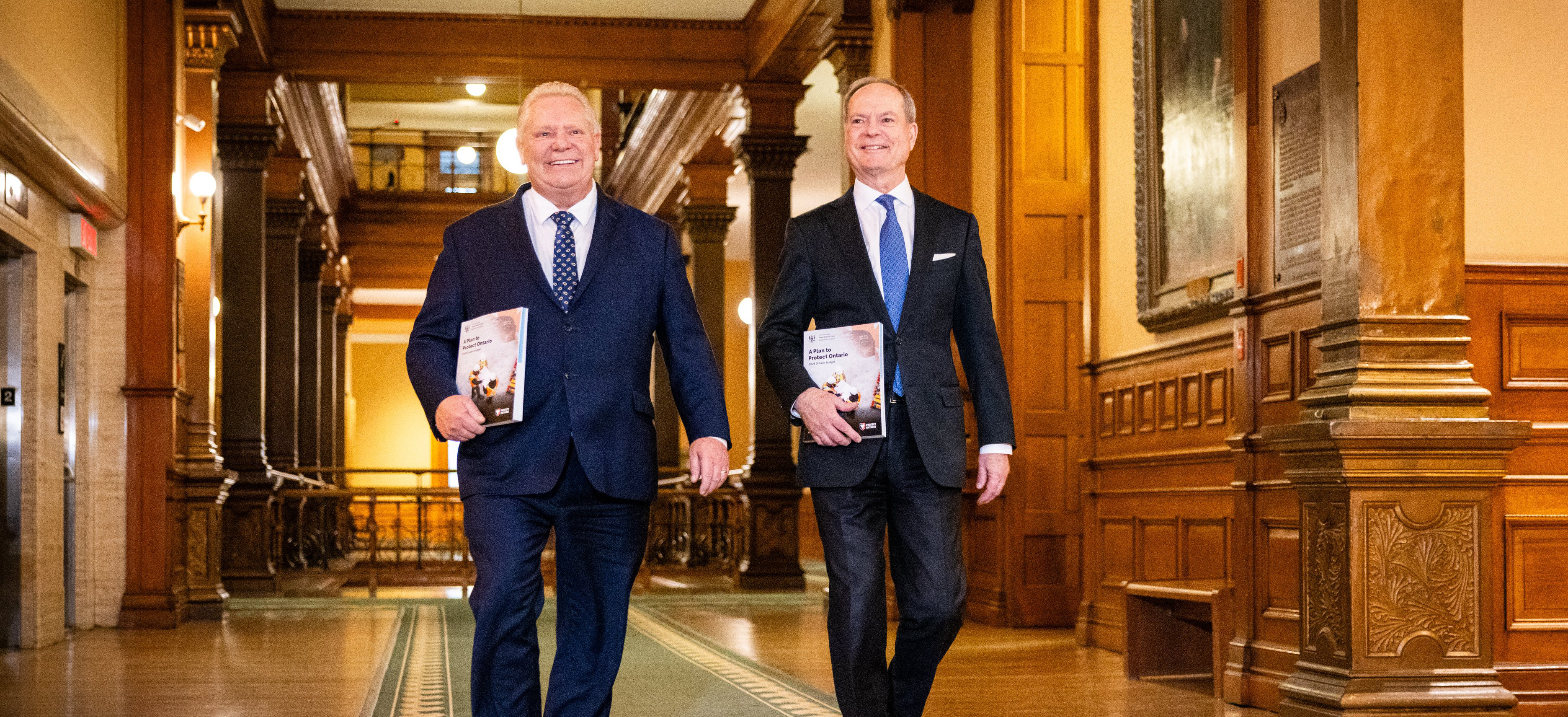
On Tuesday, British Columbia Finance Minister Brenda Bailey tabled the government's second budget of its third mandate. Titled Securing B.C.’s Future, Budget 2026 makes careful choices to secure core services, build key infrastructure, invest to build the economy, and reduce deficits starting in 2026-27.
After weeks of speculation that the province’s budget would contain massive cuts to public services or enormous tax increases, Budget 2026 provides a balanced approach. Leaning into B.C.’s strengths: abundant natural resources, a highly skilled workforce, and access to global markets, the approach aims to respond to global insecurity and trade insecurity by making strategic investments to grow the economy throughout the province. Additionally, new funding for health care, education and public safety are consistent with long-standing priorities.
Economic and fiscal situation
In a moment of global economic instability, uncertain global trade policies, and restrictive immigration measures, Budget 2026 addresses fiscal challenges through efficiency, a leaner public sector and replacing capital projects.
Based on private sector projections, slow to moderate economic growth is projected in British Columbia in the short-term, with real GDP growth projected at 1.3% this year and 1.8% in 2027. In the medium term, an average of 2.1% growth is expected through 2030 as immigration levels normalize and trade uncertainties subside.
Budget 2026 updates the 2025-26 deficit forecast from $11.1 billion at second quarter reporting to $9.6 billion. The change is largely attributed to increased income and corporate tax revenues and the benefit from the one-time $2.7 billion tobacco settlement. After the improvement in the current fiscal year, deficits are projected to increase in 2026-27 to $13.3 and decline in the subsequent years to $12.2 billion in 2027-28 and $11.4 billion by 2028-29.
B.C.’s debt-to-GDP ratio is forecasted to grow for the next three years, 30.6% in 2026-27, 34.4% in 2027-28 and 37.4% in 2028-29. Compared to peer provinces, British Columbia projects its net liabilities-to-GDP ratio to remain behind Alberta but ahead of Ontario, Quebec and the federal government, while debt-serving is expected to remain low compared to other jurisdictions.
After years of expanding the public service with hiring of health care and education professionals, individuals in the core civil service, and in agencies throughout the province, B.C. is targeting a reduction of 15,000 FTEs, or 3.4% of the existing civil service, by 2028/29. This reduction, including 2,500 positions in the core civil service, will be achieved primarily through attrition and voluntary departures, though early retirements may be employed in future, as necessary.
Investments in core services
Budget 2026 places a priority on education, public safety, and health care, with investments of more than $3.5 billion over three years. $634 million new funding is earmarked for teachers, student services and inclusive education in the K-12 system, including $167 for the Classroom Improvement Fund to add special education teachers, teacher psychologists, and counsellors. An additional $330 million is allocated to stabilize the province’s $10 a day childcare system and buy time to reconsider the existing funding model. With new funding of $139 million over three years, B.C. is aiming to reduce repeat, violent offending and chronic property crime, and support timely access to justice. That funding is on top of federal funding secured for the BC Extortion Task Force, for additional police officers, RCMP helicopter resources, and national coordination.
As expected, health care receives the largest funding boost, with $2.8 billion over three years in new funding. Of that, $2.3 billion will increase health system capacity, hiring more doctors, nurses and health-care workers, and supporting planning, development and operation of new and expanded hospitals and health care facilities. $447 million in federal funding is directed to health services for seniors, including outside of hospital treatment for complex medical conditions and improving the safety and quality of long-term care facilities. Free medications for diabetes and enhanced coverage for menopausal hormone therapy will get $653 million, allocated from federal funding.
Supporting economic growth
Acknowledging a need to diversify the economy and invest in emerging sectors, Budget 2026 aims to generate economic growth with significant funds for enhancing skilled trades training and attracting federal and private sector investment.
A total of $283 million in funding includes:
· $241 million to double skilled trades funding over three years, helping double apprenticeship seats by 2028-29
· $12 million over three years to enhance the employer training grant
· $30 million to train highly qualified professionals by adding specialized streams to existing programs, including engineering, geology, computer science, biology and aerospace
Budget 2026 allocates $400 million to the new British Columbia Strategic Investments Special Account, which will support working with the federal government to defend Canada’s sovereignty, creating jobs and economic opportunities. The special account is designed to attract investments that leverage B.C.’s strength in sectors such as clean energy, sustainable forestry manufacturing, responsible mining and clean technology.
Natural resource development has long been the backbone of the B.C. economy and Budget 2026 introduces measures to ensure that legacy continues. To build on recent progress – significantly reducing timelines for major mine applications, rapidly increasing the number of exploration permits issued, and securing more than $750 million in mining exploration investments – $40 million will be provided over three years to remove barriers and avoid duplication in permitting across natural resources and tourism. Another $80 million will be provided to support the forestry sector.
Additional incentives aimed at supporting private sector investment:
· Adding a new temporary 15% manufacturing and processing investment refundable tax credit for businesses investing in buildings, machinery and equipment used in manufacturing and processing.
· Extending the Shipbuilding and Ship Repair Industry Tax Credit until the end of 2027.
· Launching a consultation with industry and the federal government on examining the suitability of adopting a patent box regime in B.C. that could provide a reduced tax rate on income made from intellectual property in B.C.
Updating tax measures
Budget 2026 proposes to increase government revenue and protect core services through updating several taxes. New tax measures are as follows:
· Increasing the tax rate of the first income tax bracket by less than 0.6 percentage points, from 5.06% to 5.60%, and increasing the B.C. tax reduction credit. These measures combined will result in an additional $76 in income taxes for the average taxpayer in 2026, but an overall savings for more than 40% of taxpayers.
· Pausing tax bracket indexing from 2027 until 2030.
· Increasing the Speculation and Vacancy Tax rate for foreign owners and untaxed worldwide earners to 4% for the 2027 tax year, up from the current 3%.
· Increasing the Additional School Tax rates from 0.2% to 0.3% for property values between $3 million and $4 million and from 0.4% to 0.6% for property values above $4 million, effective for the 2027 tax year.
· Aligning with other provinces by expanding B.C.’s PST tax base to include professional services and removing PST exemptions for some goods and services that were once deemed essential but are not as commonly used anymore.
· Amending measures related to property taxes, including changing the interest rate structure for the Property Tax Deferment Program from simple to compound and adopting a prime plus 2% rate for new loans.
Upstream’s analysis
Despite challenging global economic conditions, trading uncertainty, and restricted immigration, with Budget 2026, the B.C. government has made careful choices to ensure it continues on the path it initially set nine years ago when it was first elected. Since 2017, New Democrats have focused on restoring public services, addressing affordability, and building critical infrastructure, all themes that continue through this year’s budget.
Facing calls for major public sector cuts and demands to immediately balance the province’s budget, Finance Minister Brenda Bailey was clear, “this is not an austerity budget.” While she emphasized the critical importance of addressing significant government deficits in the short-term by generating new revenue, identifying efficiencies and reducing the size of the public service, she was clear that the government is still committed to continuing to improve health care, education, and skills training.
Neither those seeking major cuts nor those demanding additional spending will be fully satisfied by Budget 2026. But by balancing cutting expenditures and increasing revenue, investing in core services and replacing infrastructure, incentivizing private sector investment and attracting federal government funding, the Minister has tabled a document that will ultimately help to reduce uncertainty and insecurity for British Columbians.
If you would like to discuss how British Columbia’s 2026 budget may impact your public affairs goals please reach out to info@upstreamgroup.ca to book a consultation.